

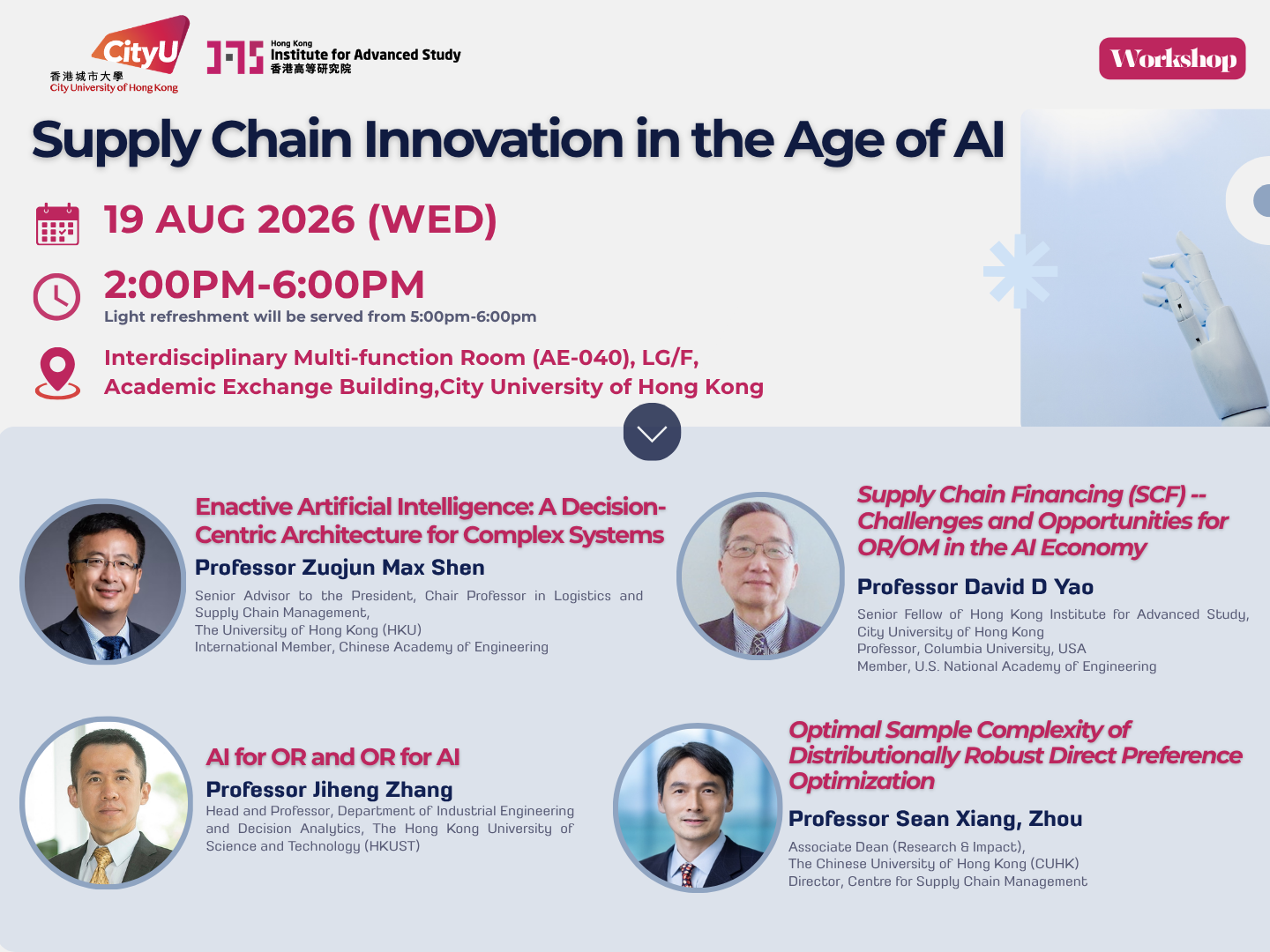
Event Schedule
| Time | Programme |
|---|---|
| 2:00 – 2:25pm | Enactive Artificial Intelligence: A Decision-Centric Architecture for Complex Systems — Professor Zuojun Max Shen |
| 2:25 – 2:30pm | Q&A Session |
| 2:30 – 2:55pm | Optimal Sample Complexity of Distributionally Robust Direct Preference Optimization — Professor Sean Zhou |
| 2:55 – 3:00pm | Q&A Session |
| 3:00 – 3:25pm | AI for OR and OR for AI — Professor Jiheng Zhang |
| 3:25 – 3:30pm | Q&A Session |
| 3:30 – 3:55pm | Supply Chain Financing (SCF) — Challenges and Opportunities for OR/OM in the AI Economy — Professor David D. Yao |
| 3:55 – 4:00pm | Q&A Session |
| 4:00 – 5:00pm | Free Discussion — Chaired by Professor Stephen Shum (Dean, College of Business, CityUHK) |
| 5:00 – 6:00pm | Light Refreshment and Reception |
Abstract and Biography
Abstract
As artificial intelligence (AI) continues to evolve and mature, recent AI practices have moved beyond large language models (LLMs) and text or image generation tasks, increasingly integrating tools, agents, and harnesses to solve real business and industrial problems. However, the power of AI is not verified under these real-world complex systems for various reasons, considering reliability, feasibility, resilience, and responsibility requirements in real commercial and industrial operations. This study synthesizes adjacent research and introduces Enactive AI as a conceptual framework for enterprise and industry reasoning, site-level decision support, and execution feedback. Four complementary roles organize the framework: an Organizational World defines operations management logic and organizational behavior world model behind an enterprise from a strategic-institutional horizon; a Site World defines a physically bounded industrial optimization and execution world model from an operational-realization horizon; Schema Intelligence provides the coupling mechanism between two world models to weave various AI applications via two models; and Enactive Decision Cycle triggers the self-evolving dynamic process to update and audit the entire framework. By foregrounding decision intelligence in complex systems, Enactive AI expands the frontier of AI from model capability to system-aware action, opening new possibilities for scalable, governable, and socially valuable AI deployment. To show the practical value of the framework, we present two industrial case studies in which Enactive AI has been deployed across major e-commerce platforms and manufacturing systems. Enactive AI points toward a future in which AI progress is measured not only by what models can generate or automate, but by how reliably intelligent systems can support consequential action, responsible governance, and durable social value in the complex systems that shape modern life, which we believe will define the next chapter of AI research and practice.
Biography

Professor Zuojun Max Shen
Senior Advisor to the President, Chair Professor in Logistics and Supply Chain Management, The University of Hong Kong (HKU)
International Member, Chinese Academy of Engineering
With research interests in logistics and supply chain management, data-driven decision making, and system optimization, Professor Shen's research programs cut through businesses, energy systems, transportation systems, smart cities, healthcare management, and environmental protection. He has worked closely with industries and has a strong track record of securing major research grants from government agencies and private sectors, such as the National Science Foundation, Department of Energy, Department of Transportation, Caltrans, IBM, GM, Safeway, HP, Bayer, Siemens, Alibaba, JD.com, and various other industrial companies and funding agencies. The total funding amount exceeds 10 million dollars. He has graduated 49 PhD students; more than half are faculty members in leading universities, and the rest work in major technological companies globally.
Internationally recognized as a top scholar, Professor Shen has published 3 books, 10 book chapters, and over 280 papers. He is an International Member of the Chinese Academy of Engineering, a Fellow of the Institute for Operations Research and the Management Sciences (INFORMS), a Fellow and past President of the Production and Operations Management Society (POMS), a Fellow of the Hong Kong Academy of Engineering Sciences, and a past President of the Society of Locational Analysis of INFORMS.
Abstract
This presentation will highlight challenges and opportunities for SCF in some of the most important supply chains in the AI economy: those of/around data centers — semiconductor (GPU/CPU/memory), energy and clean-tech, LLM training/post-training and inferencing; tokenized RWA (real-world asset) and tranchified private credit; DeFi and smart contract platforms that match supply and demand.
Biography

Professor David D. Yao
Senior Fellow of Hong Kong Institute for Advanced Study, City University of Hong Kong
Professor, Columbia University, USA
Member, U.S. National Academy of Engineering
David D. Yao is the Piyasombatkul Family Professor of Industrial Engineering and Operations Research at Columbia University, where he has been (since around 2015) the founding chair of the Financial and Business Analytics Center at Columbia Data Science Institute. His honors and awards include the Presidential Young Investigator Award from the U.S. National Science Foundation, Guggenheim Fellowship from the John Simon Guggenheim Foundation, Franz Edelman Award from the Institute for Operations Research and Management Sciences (INFORMS), SIAM Outstanding Paper Prize from the Society for Industrial and Applied Mathematics, Outstanding Technical Achievement Award from IBM Research, Great Teacher Award from the Society of Columbia Graduates, and Presidential Award for Outstanding Teaching from Columbia University. He is a Senior Fellow of the Hong Kong Institute for Advanced Studies, an IEEE Fellow, an INFORMS Fellow, and a member of the U.S. National Academy of Engineering, and has served on the Board on Mathematical Sciences and Analytics of the U.S. National Academies of Science, Engineering and Medicine.
Abstract
This talk explores the interplay between Operations Research (OR) and Large Language Models (LLMs) through two complementary research directions.
In the first part, we study the scheduling of LLM inference workloads across large GPU clusters. LLM inference involves two phases: a compute-intensive prefill phase that processes user input, and a memory-bound decode phase that generates output tokens. When these phases share GPU resources, prefill tasks throttle concurrent decodes, creating state-dependent contention that is further complicated by workload heterogeneity across applications. We formulate this as a multiclass many-server queueing network with state-dependent service rates, grounded in empirical iteration-time measurements. We analyze the fluid approximation and solve steady-state linear programs that characterize optimal resource allocation. We design gate-and-route policies that regulate prefill admission and decode routing, and prove their asymptotic optimality in the many-GPU limit. We further extend the framework to incorporate service level indicators such as latency and fairness. Numerical experiments demonstrate that our policies outperform standard serving heuristics.
In the second part, we consider the reverse direction: using LLMs to automate OR analysis. Formulating optimization models from natural language and generating executable solver code could reduce reliance on scarce expert knowledge, but LLMs suffer from probabilistic inconsistency and existing methods face a data efficiency dilemma. We propose OR-R1, a framework that integrates supervised fine-tuning with Test-Time Group Relative Policy Optimization (TGRPO). TGRPO extracts reliable training signals from unlabeled data by generating multiple candidate solutions and treating the solver-verified consensus as the ground truth. We provide theoretical guarantees for gradient convergence and show that this voting-based proxy consistently maximizes true solution accuracy. OR-R1 requires only 10% of the training data used by prior methods, yet achieves state-of-the-art accuracy across eight OR benchmarks.
Biography

Professor Jiheng Zhang
Head and Professor, Department of Industrial Engineering and Decision Analytics, The Hong Kong University of Science and Technology (HKUST)
Jiheng Zhang is a Professor in the Department of Industrial Engineering and Decision Analytics at HKUST, where he also holds a joint appointment in the Department of Mathematics. His research interests include stochastic modeling and optimization, statistical learning, numerical methods, and algorithms, with applications in operations management, large communication networks, and financial technology. He serves as an associate editor for several top journals, including Operations Research, Stochastic Systems, and Probability in the Engineering and Informational Sciences. Since 2018, he has been the Director of the EPI-One Lab, leading various applied projects with industry partners such as Huawei and Webank. He holds several patents in areas such as large-scale production planning and blockchain consensus mechanism design. He earned his Ph.D. in Operations Research from the H. Milton Stewart School of Industrial and Systems Engineering at the Georgia Institute of Technology in 2009. He also holds an M.S. in Mathematics from Ohio State University and a B.S. in Mathematics from Nanjing University.
Abstract
Direct Preference Optimization (DPO) has become a central approach for aligning language models from pairwise preference data, but its statistical behavior under distributional shift remains poorly understood. This paper studies distributionally robust DPO, where the prompt distribution at deployment is allowed to vary within a Wasserstein uncertainty set around the nominal data-generating distribution. For a finite prompt space and a log-linear policy class, we analyze the plug-in estimator that minimizes the empirical distributionally robust preference loss. We derive high-probability finite-sample guarantees for estimating the robustly optimal policy parameter. In particular, we prove an upper bound and show that this rate is minimax optimal up to logarithmic terms by providing a matching lower bound. To further understand the dependence on the robustness radius, we derive a radius-dependent upper bound. Our result indicates that as the robustness radius converges to 0, the sample complexity of our distributionally robust DPO method converges to the optimal sample bound for the standard non-robust DPO problem. Together, these results characterize the optimal sample complexity of distributionally robust preference optimization and clarify the statistical cost of robustness to prompt distribution shift. This is joint work with Will Ma (Columbia), Xiaoyu Fan and Zhengyuan Zhou (both at NYU Stern).
Biography

Professor Sean Zhou
Associate Dean (Research & Impact), The Chinese University of Hong Kong (CUHK)
Director, Centre for Supply Chain Management
Sean Zhou is Professor of Department of Decisions, Operations and Technology, CUHK Business School, and Professor in Department of Systems Engineering and Engineering Management (by courtesy), at The Chinese University of Hong Kong (CUHK). He currently serves as the Associate Dean (research and impact) of CUHK Business School. He has held visiting positions at National University of Singapore and University of Toronto. He received his Ph.D. in Operations Research from North Carolina State University. His main research interests are inventory management, pricing, sustainable operations, data-driven supply chain optimization, and operations and marketing interface. He serves as Area Editor (Inventory and Supply Chain Optimization) of OR Letters, Senior Editor of POMS, and Associate Editor of various journals including Naval Research Logistics and Service Science.
Event Information


- Photo
- Video
- News
- Poster